
Why E-Invoicing Is Now a Strategic Decision in the UAE
The UAE is implementing a Continuous Transaction Controls (CTC) model based on the Peppol framework, requiring businesses to issue, transmit, and report invoices through an FTA-approved Accredited Service Provider (ASP) in real time or near-real time. This is a structural change to how transactions are recorded, not a minor software upgrade, which is why a Peppol e-invoicing solution in UAE has quickly become a board-level consideration rather than a back-office one.
For your organisation, this creates two distinct pressures. The first is regulatory: non-compliance after the mandate deadline carries financial penalties and operational disruption. The second is competitive: businesses that automate early capture efficiency gains while peers are still processing paper and PDF invoices manually.
A strong business case speaks to both. It frames the right e-invoicing software in UAE not as a grudge purchase forced by regulation, but as an investment that simultaneously removes risk and unlocks measurable value.
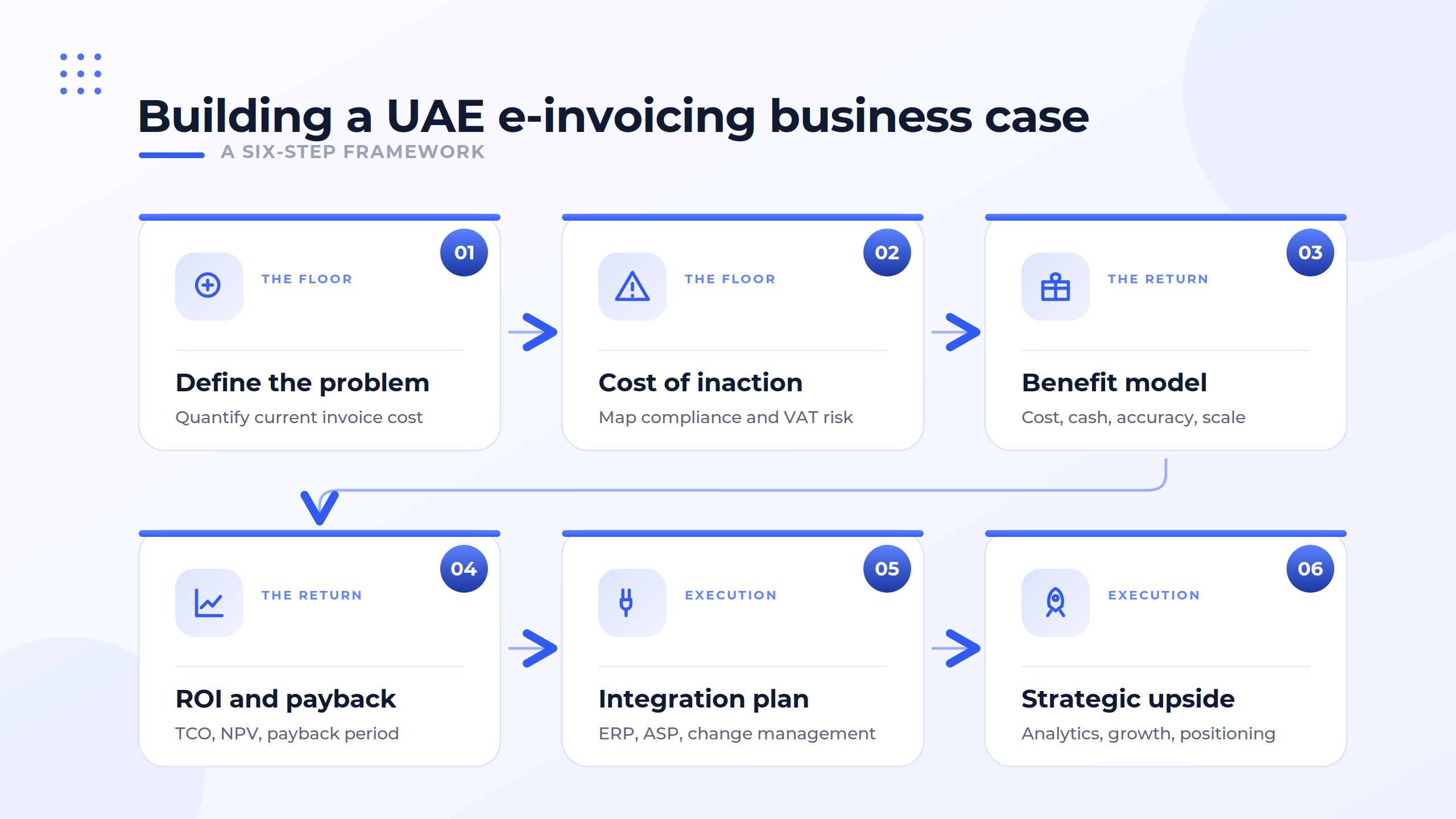
Step 1: Define the Problem in Quantifiable Terms
Decision-makers respond to numbers, not generalities. Begin by documenting the current cost and friction of your existing invoicing process.
Calculate the fully loaded cost of processing a single invoice today. Include staff time spent on data entry, validation, matching, approval routing, dispute resolution, and archiving. Industry benchmarks place manual invoice processing anywhere from several dirhams to over a hundred dirhams per invoice depending on complexity, error rates, and headcount.
Then capture the hidden costs that rarely appear on a spreadsheet: late-payment penalties, missed early-payment discounts, the cost of errors and rework, storage and audit-preparation effort, and the opportunity cost of finance staff doing repetitive clerical work instead of analysis.
Multiply per-invoice cost by annual invoice volume to arrive at your baseline. This single figure becomes the anchor of your entire business case.
Step 2: Map the Cost of Non-Compliance
The regulatory dimension is what makes the UAE e-invoicing case urgent rather than optional. Quantify the downside of inaction.
Outline the penalty structure associated with failing to meet the mandate, the risk of invoices being rejected or deemed invalid for VAT recovery, and the reputational exposure of being unable to transact with partners who require compliant e-invoices. For many organisations, the inability to reclaim input VAT on non-compliant invoices alone justifies the investment.
Position compliance as a floor, not a ceiling. The mandate sets the minimum bar; the right software clears it automatically while delivering additional benefits.
Step 3: Build the Benefit Model
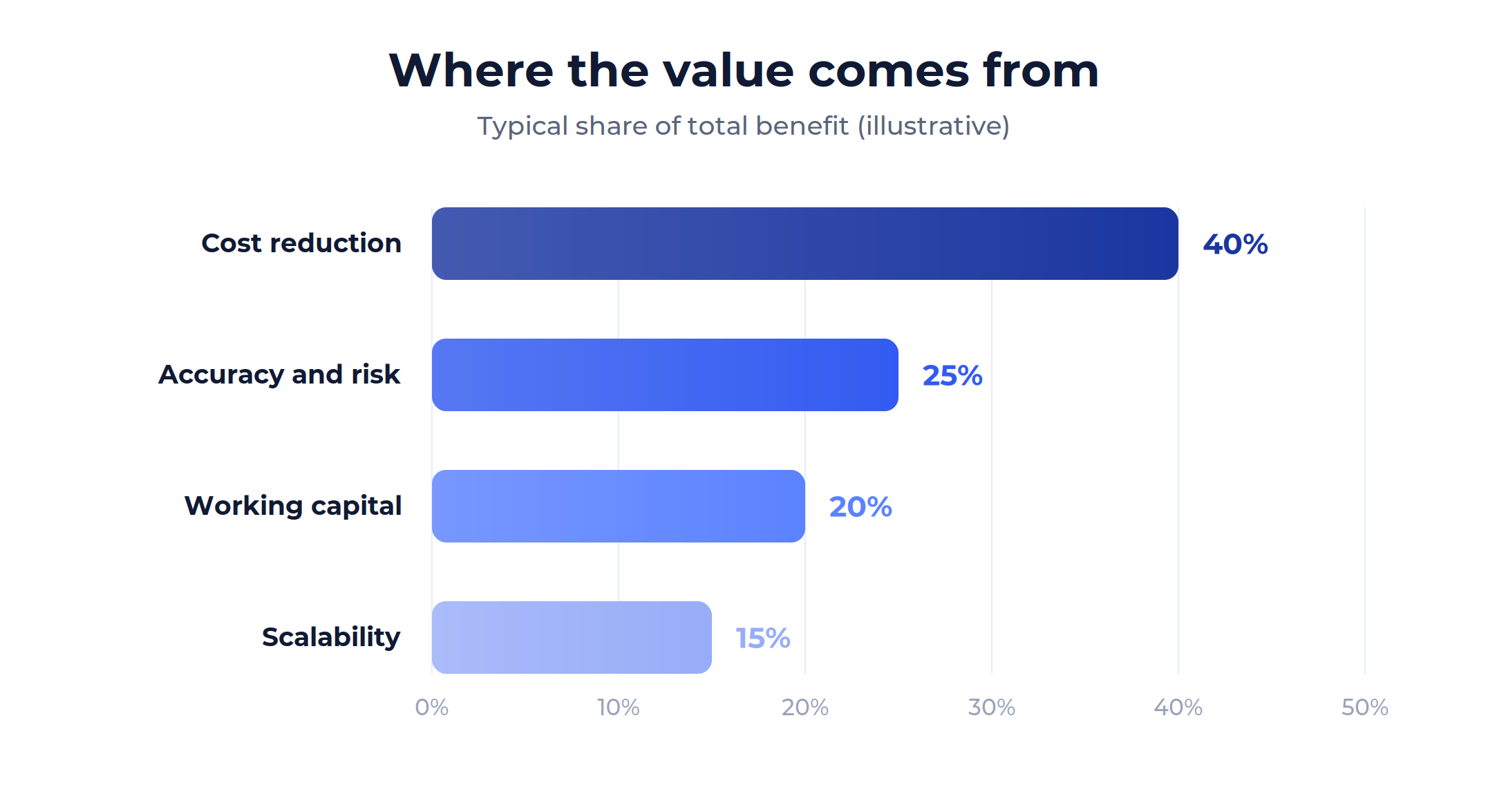
This is where a persuasive business case separates itself from a compliance memo. Translate your electronic invoicing solution in UAE into concrete, categorised benefits.
On cost reduction, model the drop in per-invoice processing cost after automation. Mature e-invoicing implementations routinely cut processing costs by sixty to eighty percent by eliminating manual data entry, automating three-way matching, and reducing exceptions.
On working capital, factor in faster invoice cycles that improve cash-flow predictability, reduce days sales outstanding, and let you capture early-payment discounts that were previously missed.
On accuracy and risk, account for the near-elimination of manual keying errors, automatic validation against tax rules, and a complete, audit-ready digital trail that slashes audit-preparation time.
On scalability, note that automated processing absorbs invoice-volume growth without proportional headcount increases, which matters for any organisation planning expansion.
Step 4: Calculate ROI and Payback Period
Bring cost and benefit together into the metrics finance leaders expect.
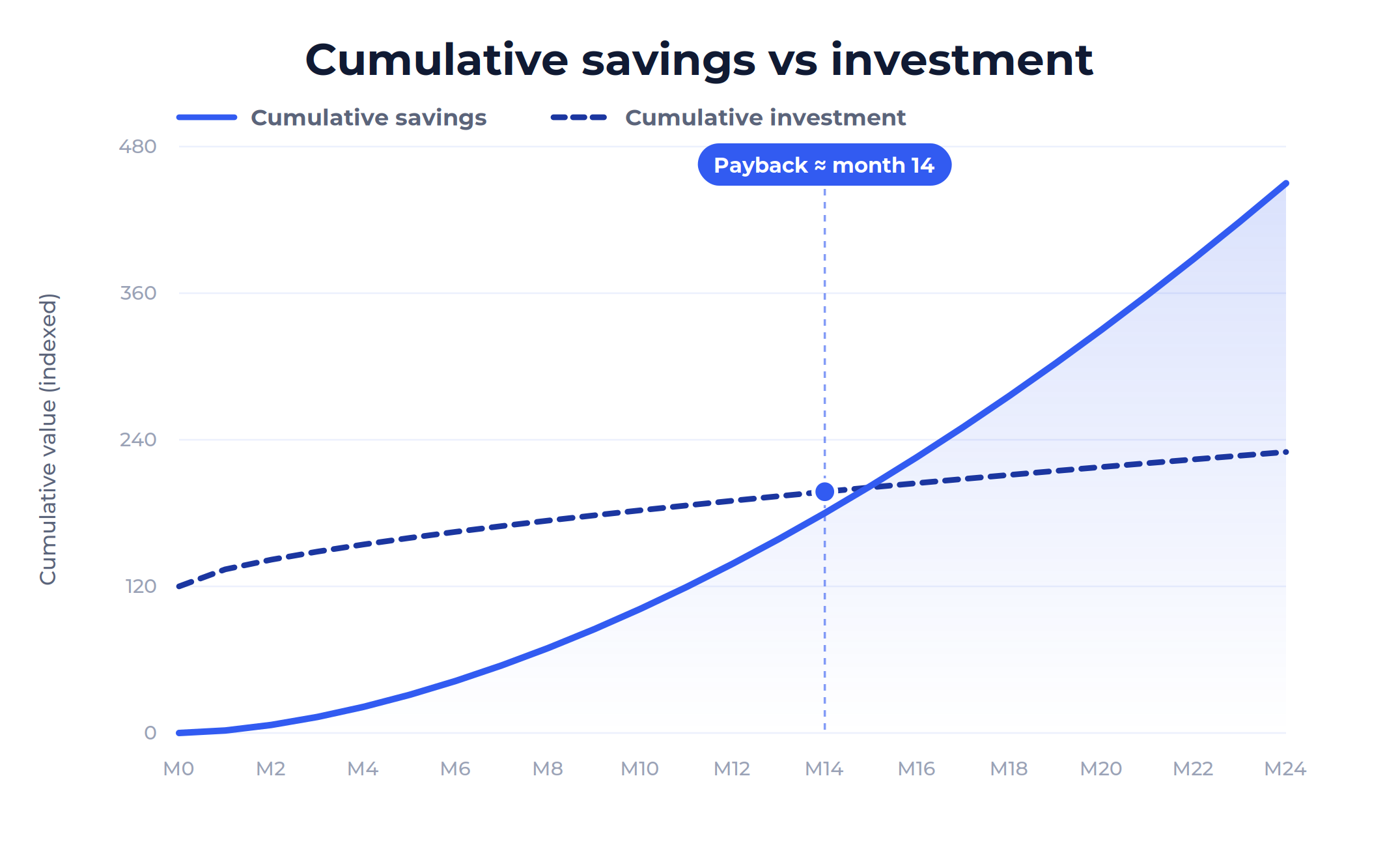
Present total cost of ownership over a three-year horizon, including software subscription or licence fees, implementation and integration costs, training, and ongoing support. Set this against cumulative annual savings from reduced processing cost, recovered discounts, avoided penalties, and reclaimed staff capacity.
From these figures, derive net present value, return on investment as a percentage, and most importantly the payback period. A compelling UAE e-invoicing case often shows payback inside twelve to eighteen months, which makes approval significantly easier.
Step 5: Address Integration and Change Management
A common reason business cases stall is unaddressed implementation risk. Pre-empt the objections.
Demonstrate how the software integrates with your existing ERP or accounting system, whether that is SAP, Oracle, Microsoft Dynamics, or a regional solution. Explain the FTA-approved Accredited Service Provider (ASP) model and how the platform handles connectivity to the FTA's reporting infrastructure. Outline a realistic implementation timeline with phased milestones, and include a change-management plan covering staff training and process redesign.
Showing that you have thought through execution signals maturity and de-risks the decision for approvers.
Step 6: Present the Strategic Upside
Close the business case by lifting it above pure cost-benefit arithmetic.
Real-time invoice data creates a foundation for better financial analytics, tighter cash-flow forecasting, and faster month-end close. A compliant, digital-first finance function strengthens relationships with large enterprise and government clients who increasingly mandate electronic transactions. And early adoption positions your organisation as a forward-looking partner rather than a laggard scrambling at the deadline.
This is the narrative that turns a defensive compliance spend into an offensive strategic investment.
Choosing the Best E-Invoicing Software in UAE
The strength of your business case ultimately rests on selecting a platform that delivers the benefits you have promised. When you compare the e-invoicing systems in UAE on the market, prioritise the ones that are built for the local mandate from the ground up: an FTA-approved Accredited Service Provider (ASP), fully Peppol-ready, integrating cleanly with your existing ERP, scaling with transaction volume, offering robust validation and reporting, and backed by strong local support that understands UAE regulatory specifics.
This is the filter that separates a genuine, top e-invoicing solution in UAE from a generic global tool retrofitted for compliance. The best Peppol-ready e-invoicing software in UAE will not just keep you compliant; it will become the e-invoicing partner that carries your finance function through every future phase of the mandate.
Conclusion
Building a business case for an e-invoicing solution in UAE comes down to three pillars: quantifying the true cost of your current process, mapping the regulatory and financial risk of inaction, and modelling the measurable returns of automation. Present these with clear ROI metrics and a credible implementation plan, and you transform a compliance obligation into a confident, board-ready investment decision.
The organisations that move now, partnering with a leading e-invoicing solution in UAE rather than scrambling at the deadline, will not only meet the mandate; they will emerge with leaner, smarter, and more resilient finance operations.
Frequently Asked Questions
1. Is e-invoicing mandatory for all businesses in the UAE?
The UAE is implementing e-invoicing through a phased mandate under the Federal Tax Authority, beginning with larger taxpayers and expanding over time. While timelines and thresholds are being rolled out in stages, the long-term direction is clear: an electronic invoicing system in UAE will become the standard for VAT -registered businesses. Organisations should confirm their specific applicable date with the FTA and prepare ahead of it rather than waiting for the deadline.
2. How long does it take to implement an e-invoicing system in a UAE organisation?
Implementation timelines vary by organisation size and system complexity, but most mid-sized businesses can expect a phased rollout over a few weeks to a few months. The main variables are the depth of ERP integration required, data-quality clean-up, and staff training. Choosing an FTA-approved Accredited Service Provider (ASP) with pre-built connectors to your existing accounting system significantly shortens deployment time.
3. What is the typical return on investment for e-invoicing software ?
Most organisations achieve payback within twelve to eighteen months. The return is driven by sharply reduced per-invoice processing costs, fewer errors and disputes, recovered early-payment discounts, avoided compliance penalties, and freed-up finance staff capacity. Mature implementations commonly cut invoice processing costs by sixty to eighty percent.
4. Does e-invoicing software integrate with my existing ERP or accounting system?
Leading e-invoicing software in UAE like SMARTeIS by Skill Quotient Technologies are designed to integrate with major ERP and accounting systems such as SAP, Oracle, Microsoft Dynamics, and regional solutions. The best providers offer pre-built connectors and API-based integration so invoices flow automatically between your existing systems and the FTA reporting infrastructure, without manual re-entry.
5. What happens if my organisation fails to comply with the UAE e-invoicing mandate?
Non-compliance can result in financial penalties, rejected or invalid invoices, and the inability to reclaim input VAT on non-compliant transactions. There is also commercial risk, as partners and clients who require compliant e-invoices may be unable to transact with you. Investing in compliant software ahead of your applicable deadline removes this exposure entirely.