
Why Six Months, and Why Start Now
E-invoicing is not a piece of software you switch on the night before. Fawtara runs on the Peppol five-corner model, in which your invoices are validated, digitally signed, transmitted through an accredited service provider, and reported to the Oman Tax Authority (OTA) in near real time. Reaching that point involves ERP changes, data cleanup, provider selection, integration, and live testing, and each of those stages carries its own lead time.
Six months is the realistic minimum for a mid-sized business running a single ERP, and larger enterprises with multiple systems or branches should allow longer. Even companies that are not in the first wave can be pulled forward when their major customers go live, so choosing an OTA compliant e-invoicing solution early is rarely wasted effort.
Who Needs Fawtara E-Invoicing in Oman
Fawtara covers Oman B2B e-invoicing first, with Oman B2G e-invoicing for government entities following in a later phase, and it ultimately reaches every VAT-registered taxpayer. In practice that means Oman VAT e-invoicing becomes part of day-to-day operations for organisations of every size, from SMEs issuing a handful of invoices a month to large enterprises processing thousands. An e-invoicing solution for SMEs in Oman needs to be simple and affordable, while an enterprise e-invoicing platform must handle high volumes, multiple entities, and complex tax scenarios, but both must meet the same compliance standard.
The mandate also cuts across industries. Whether you run e-invoicing for retail, manufacturing, logistics, hospitality, construction, oil and gas, healthcare, telecom, banking, trading companies, or free zones, the underlying obligation is identical even though invoice patterns differ widely between them. Businesses in Muscat, Salalah, Sohar, and across the wider regions are all in scope, and as other GCC markets adopt similar frameworks, a Fawtara-ready setup positions Omani businesses well for a broader GCC e-invoicing future.
The common thread is that Fawtara is fundamentally a VAT and tax compliance requirement rather than an optional efficiency project. Treating your chosen platform as VAT compliance software, not just billing software, keeps the focus where it belongs: on issuing valid, accepted invoices every time.
How Fawtara Works: The Technical Picture
A short technical grounding makes the roadmap far easier to follow. Fawtara extends the familiar Peppol four-corner model by adding the tax authority as a fifth corner. You, the supplier, create the invoice in your ERP; your accredited service provider acts as the sending Peppol Access Point in Oman; the buyer's service provider is the receiving Access Point; the buyer is the final recipient; and the OTA sits as the fifth corner, receiving the reported invoice data in near real time.
The two Access Points exchange documents across the Peppol network using the AS4 messaging protocol, discovering each other through the Peppol directory and a Service Metadata Publisher using standardised participant identifiers. This is also what enables cross-border Peppol invoicing from Oman, since the same network connects participants internationally. Crucially, you never connect to the OTA yourself; your provider handles transmission, routing, and reporting on your behalf, which is what makes real-time e-invoicing in Oman practical.
The document itself follows PINT-OM, Oman's localisation of the Peppol International billing specification, which builds on Peppol BIS Billing 3.0 and the EN 16931 semantic standard and is expressed as a UBL e-invoice in XML. Alongside that machine-readable XML, a human-readable PDF/A-3 is produced, ideally with the XML embedded so a single file carries both layers, and each document also carries a QR code, a digital signature, or cryptographic stamp, and a unique identifier.
Before an invoice is accepted it is validated against the OTA Data Dictionary, which defines the mandatory and conditional fields, the permitted code lists for tax categories, units of measure, and currencies, and the business rules an invoice must satisfy. Any invoice that breaks a rule is rejected, so e-invoicing validation, reporting, and archiving all need to be handled correctly from day one. Because the exact schema versions and rules are still being finalised, it is wise to build a solution that can absorb updates rather than one hard-coded to a draft.
The 6-Month Fawtara Action Plan
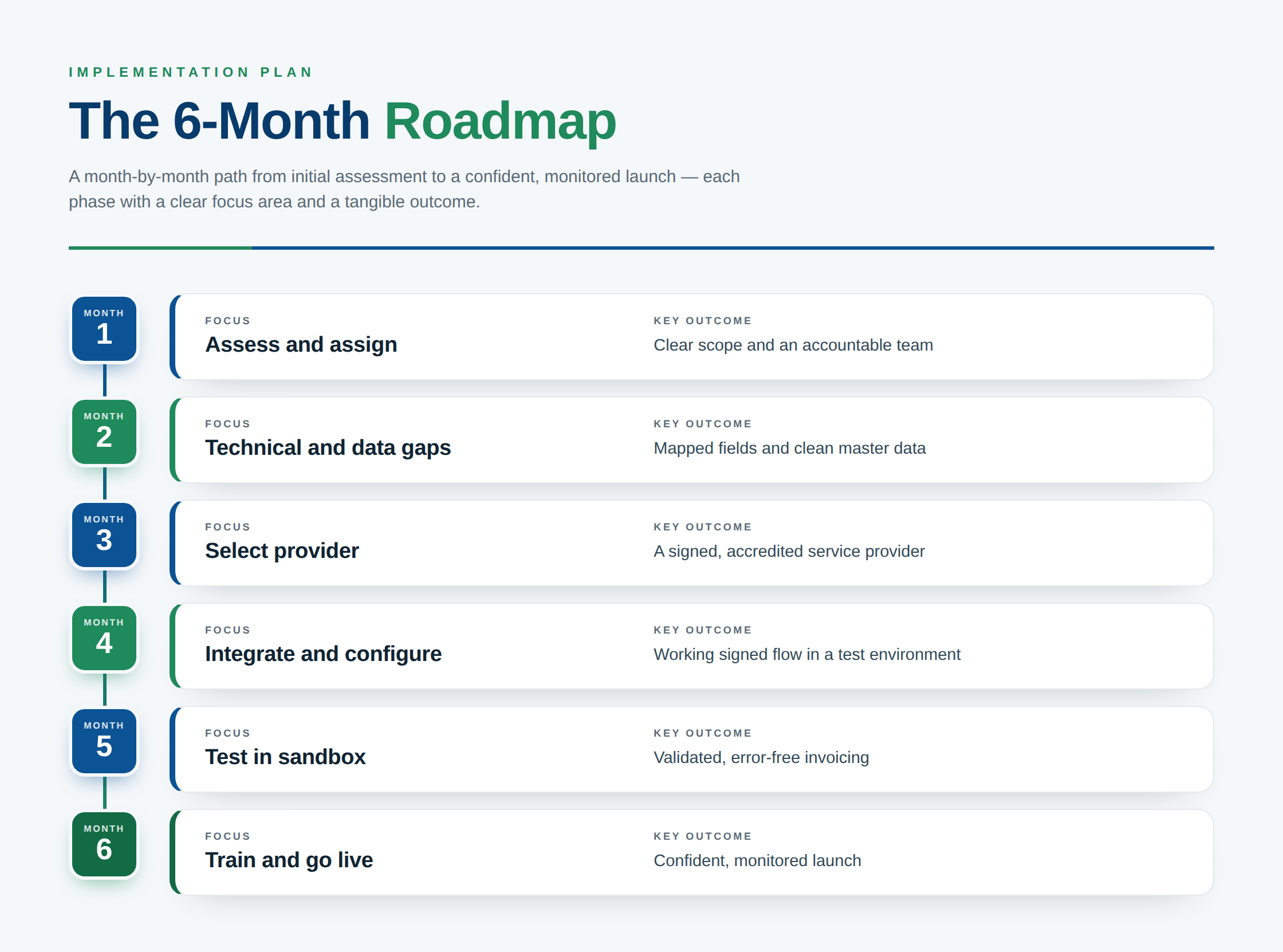
Month 1: Assess and assign ownership
The first month is about clarity rather than technology. Begin by confirming your phase: check whether you have received an OTA notification or readiness survey and pin down your exact go-live date. Because Fawtara touches finance, tax, IT, and operations alike, appoint a single accountable project owner supported by a small cross-functional team rather than leaving it to one department.
From there, map your full invoicing landscape, documenting every system that issues invoices, credit notes, and debit notes, including manual or spreadsheet-based processes and any third-party billing tools. Note where your major customers and suppliers sit in the rollout, since a partner in an earlier phase can effectively bring your deadline forward.
Finally, size the work honestly by estimating your invoice volumes and complexity, setting a budget that accounts for provider fees, system upgrades, internal hours, and possible Fawtara implementation services or e-invoicing consultation in Oman, and agreeing on what "ready" actually means so everyone is working towards the same target.
Month 2: Close the technical and data gaps
With scope clear, the second month measures your systems against what Fawtara genuinely demands. Start by testing your ERP's output to confirm whether it can natively produce a UBL 2.1 XML in the PINT-OM format and a compliant PDF/A-3, generate QR codes, and apply digital signatures. Many legacy and on-premise systems cannot do this without help, which is why ERP-integrated e-invoicing in Oman, whether for SAP, Oracle, Microsoft Dynamics, or a cloud accounting package, usually relies on a connector or middleware layer.
Next, map each business term the OTA requires, from seller and buyer tax identifiers to line-item detail and tax-category codes, to a field in your system, flagging every mandatory field you do not currently capture. The largest single cause of rejected invoices is poor master data, so this is the moment to audit and clean your tax registration numbers, customer and supplier identifiers, item codes, and unit-of-measure values, and to align your internal currencies, units, and tax codes with the OTA's permitted code lists.
It also pays to review your invoice numbering for unique, gap-free sequencing, to decide how special cases such as exempt supplies, zero-rated exports, and reverse-charge transactions will be represented, to plan how any retail or cash sales will be reported, and to assess whether your connectivity and uptime can support near real-time transmission. Where systems fall short, scope an e-invoicing migration plan now rather than discovering the gap during testing.
Month 3: Select your accredited service provider
Because you cannot connect your ERP directly to the OTA, choosing the right e-invoicing partner in Oman is the decision that de-risks every month that follows. Shortlist e-invoicing solution providers in Oman that are OTA-accredited, Peppol-certified, locally registered, and proven on your specific ERP, and insist on proof that they are a genuinely approved e-invoicing service provider rather than relying on marketing labels, distinguishing real accreditation from "pre-approved" status by asking exactly what stage they have reached.
Look closely at the security credentials of any e-invoicing software provider in Oman, such as ISO 27001 and SOC 2 Type II, and how they encrypt data in transit and at rest, and understand their integration method, whether that is a prebuilt connector, a REST API, or a file-based exchange, along with who manages the AS4 transport, participant registration, and certificate handling.
Beyond the technology, compare pricing models so you understand whether you pay per invoice, per volume tier, or a flat fee, and ask whether an e-invoicing software demo, free trial, or transparent pricing is available before you commit. Scrutinise the service-level agreement for uptime and support hours in Oman time, confirm the platform scales to your peak month-end volumes, ask for live local references, and read the exit terms so you know you own your data. Agree timelines that leave integration and testing comfortably ahead of your deadline.
Month 4: Integrate and configure
The fourth month is the build phase. Connect your ERP to the Access Point through your provider's API or connector, with the provider typically managing the AS4 transmission, the participant lookup, and your Peppol identifier, then set up digital signing by obtaining and configuring the certificate that stamps every document.
Configure your document templates for invoices, credit notes, and debit notes so each maps to the correct XML structure, QR code, and PDF/A-3 layout, and get the tax and rounding logic right so totals always reconcile to the underlying line items, including multi-rate, foreign-currency, and multi-entity scenarios where they apply.
Equally important is the unglamorous plumbing: design clear workflows for validation responses, rejections, retries, and error queues so that a failed invoice is caught and corrected rather than lost, plan compliant e-invoicing archiving of the signed XML and PDF/A-3 for the retention period required under Omani VAT law in a tamper-evident and retrievable form, track certificate expiry dates so a lapsed certificate never halts your billing, and stand up a simple monitoring view that shows accepted, rejected, and pending invoices. Aim to have a working end-to-end flow running in a test environment by the end of the month.
Month 5: Test in the sandbox
Testing is where confidence is built, so the fifth month should be spent running real invoice scenarios end to end through the OTA sandbox and your provider's test environment. Validate that structured invoices pass Data Dictionary checks, that signatures verify, that QR codes scan, and that PDF/A-3 files are conformant, and confirm that the reported data actually reaches the OTA as the fifth corner and returns the expected acknowledgement.
Push beyond the happy path to the cases that trip most go-lives, including cancellations, corrections, foreign-currency invoices, exempt and zero-rated supplies, and reverse-charge transactions, and if you issue high volumes, run load tests to be sure performance holds at month-end peaks.
Have your finance and operations staff carry out user acceptance testing on realistic invoices and sign off, confirm that you can receive and process inbound e-invoices from suppliers rather than only sending your own, retrieve an archived invoice to prove it remains intact and audit-ready, and reconcile the e-invoice data against your ledgers and VAT figures so the numbers agree. Treat every rejection as a finding to resolve before go-live, never after, and keep a documented issue log so nothing slips into production unfixed.
Month 6: Train, soft-launch, and go live
The final month is about people and a controlled switch-on. Train your finance, sales, and operations teams on the new workflow and, just as importantly, on how to read validation responses and act on rejections, and run a short parallel period where feasible so issues surface against real transactions before you fully commit.
Prepare a fallback plan so that a technical hiccup cannot stop you from billing customers, and tell your trading partners that you are now issuing e-invoices and confirm how they will receive and acknowledge them. When you go live, monitor closely for the first few weeks, checking the dashboard daily, tracking rejection rates and signature or reporting errors, and resolving problems quickly while your support desk is briefed to handle billing queries from day one.
Schedule a review at thirty and ninety days to capture lessons and tighten the process, and keep this playbook ready to reuse as further entities or phases come into scope.
6-Month Roadmap Summary
Common Pitfalls to Avoid
The most damaging mistake is simply starting too late, because integration and testing always take longer than expected and there is no room to compress the final weeks. It is equally risky to treat Fawtara as an IT-only project when it is just as much a finance, tax, and operations change, or to underestimate data quality, since clean master data prevents the majority of rejections.
On the commercial side, choosing a provider on price alone tends to cost more later than it saves, as accreditation, support, and genuine ERP fit matter far more than the cheapest quote. Finally, avoid hard-coding to draft specifications while the schema and validation rules are still evolving, and never skip edge-case testing, because credit notes, corrections, and reverse-charge flows are exactly where unprepared go-lives come undone.
Choosing the Right Fawtara Solution Provider
The roadmap is only as good as the platform you run it on. The best e-invoicing software in Oman combines OTA accreditation with Peppol certification, integrates cleanly with your ERP, scales from SMEs to large enterprises, and is backed by local support that understands the Oman e-invoicing mandate in detail. When you compare a leading e-invoicing solution in Oman against a basic billing tool, look for proven validation, reporting, and archiving, transparent pricing, and a partner that can guide you through every stage of implementation.
SMARTeIS by Skill Quotient Technologies is one such Fawtara solution provider, available in Oman as an e-invoicing service provider built on the Peppol five-corner model and supporting PINT-OM (UBL 2.1 XML) and PDF/A-3. Positioned as smart e-invoicing for Oman, SMARTeIS integrates with major ERP systems and is designed to give Omani businesses, across industries and sizes, a practical and OTA compliant path to readiness ahead of the phased deadlines.
Conclusion
Fawtara compliance is a project with a hard deadline, and six months is the window in which a well-run business can reach it comfortably. The shape of the work is straightforward even where the detail is technical: understand your scope, fix your data, choose an accredited partner, integrate and sign, test thoroughly, and launch with your teams trained and ready.
Companies that begin early will experience e-invoicing as an upgrade to faster, cleaner, and more transparent billing rather than a last-minute scramble. Find your go-live date, count back six months, and start today.
Frequently Asked Questions
1. What is Fawtara e-invoicing?
Fawtara is Oman's national e-invoicing system, introduced by the Oman Tax Authority. It requires businesses to issue structured, digitally signed electronic invoices through accredited service providers on the Peppol network, replacing paper and ordinary PDF invoices.
2. How does Fawtara work?
Fawtara uses a Peppol five-corner model. Your invoice is created in your ERP, sent through your accredited service provider, delivered to the buyer's service provider and the buyer, and reported to the OTA in near real time. You never connect to the OTA directly.
3. What are the Oman e-invoicing requirements?
Invoices must be structured UBL 2.1 XML in the PINT-OM format, accompanied by a PDF/A-3, a QR code, and a digital signature, validated against the OTA Data Dictionary, and transmitted through an OTA-accredited Peppol Access Point.
4. When are the Oman e-invoicing deadlines?
Phase 1 begins in August 2026 for around 100 of the largest VAT-registered taxpayers, Phase 2 covers all large VAT-registered companies from February 2027, and Phase 3 covers the remaining VAT-registered businesses from August 2027, with government entities in a later phase. Confirm your specific date with the OTA.
5. How long does Fawtara implementation take?
For a mid-sized business with one ERP, around six months is realistic. Larger enterprises with multiple systems or branches should allow more time for integration and testing.
6. Can I connect my ERP directly to the Oman Tax Authority?
No. Every compliant invoice must pass through an OTA-accredited service provider acting as a Peppol Access Point, which transmits documents over AS4 and reports the data to the OTA.
7. What is the most common reason e-invoices get rejected?
Poor master data. Incomplete or inconsistent tax numbers, customer details, item codes, and code-list values cause most validation failures, which is why a data audit early in the roadmap is essential.
8. Do small businesses and SMEs need to prepare for Fawtara?
Yes. All VAT-registered businesses are expected to be covered by August 2027, and an SME may need to be ready sooner if its larger customers require it. Preparing early gives smaller firms a smoother transition.
9. Does Fawtara work with SAP, Oracle, and Microsoft Dynamics?
Yes. Most accredited providers offer ERP-integrated e-invoicing for major systems such as SAP, Oracle, and Microsoft Dynamics, as well as cloud accounting platforms, usually through a connector or API.
10. What happens if I miss my Fawtara go-live deadline?
Non-compliant invoices can be rejected, disrupting your ability to bill customers and exposing you to potential penalties. Building in time for testing well before the deadline is the safest approach.
Start your 6-month countdown now. Talk to the SMARTeIS team.