
Key Takeaways
- Fawtara is Oman's national e-invoicing program led by the Oman Tax Authority (OTA) (OTA), rolling out in phases from 2026 to 2028.
- All VAT-registered businesses must issue invoices in structured electronic formats (XML/JSON) through accredited service providers.
- Penalties under Royal Decree No. 121/2020 range from OMR 1,000 to OMR 20,000, with imprisonment of up to 3 years.
- For CFOs, success depends on budget, vendor selection, ERP alignment, governance, and multi-jurisdictional planning.
Fawtara at a Glance
Fawtara is the Oman Tax Authority's official e-invoicing framework, built on the Peppol five-corner decentralised model . VAT-registered businesses must issue structured digital invoices through accredited service providers (ASPs), which validate the invoice in near real time with the OTA before delivering it to the buyer. Records must be securely archived for at least 10 years.
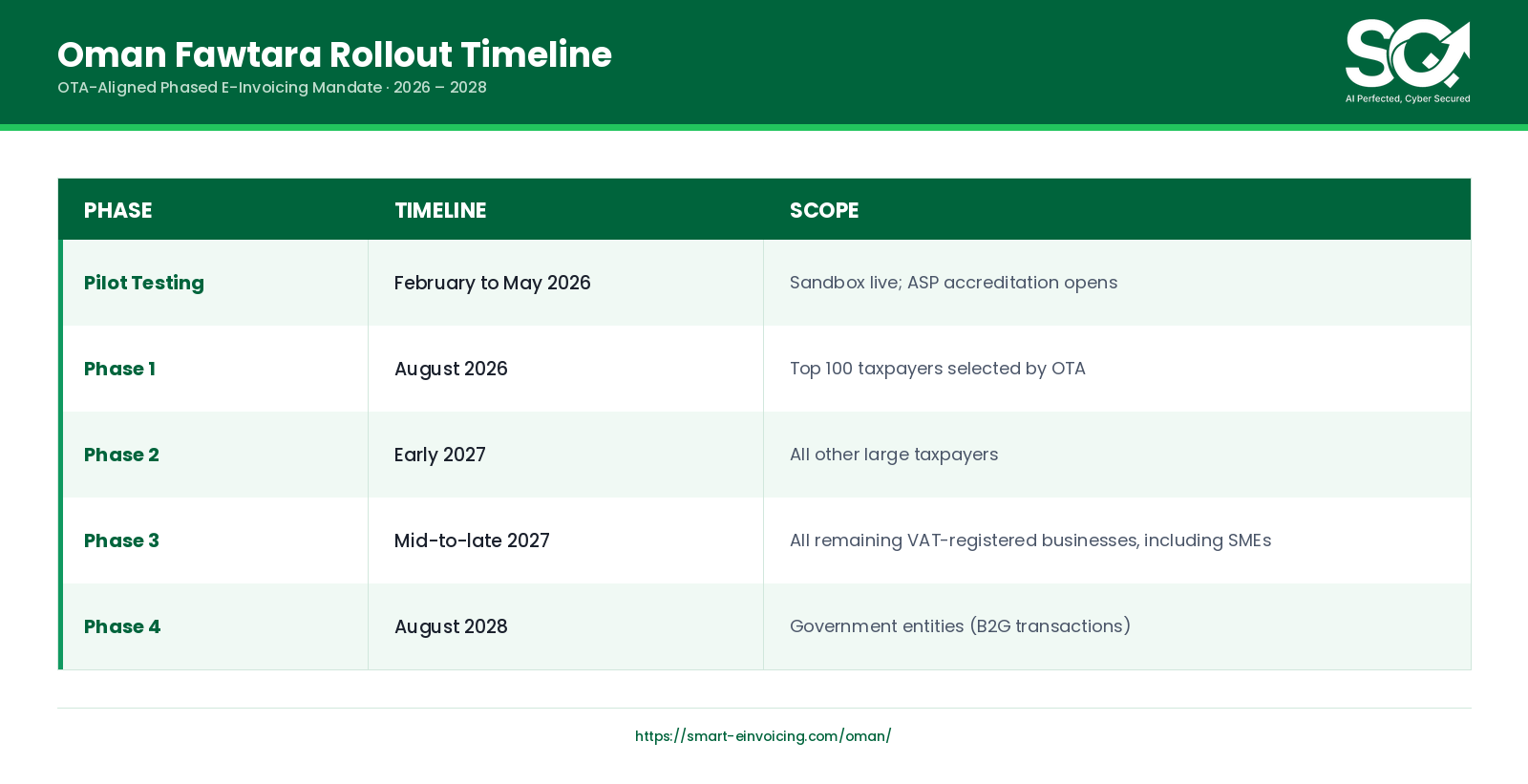
For finance leaders, readiness assessments should already be underway.
7 Strategic Decisions Every Oman CFO Must Make
- Frame Compliance as Strategy, Not a Checkbox: Done right, the mandate unlocks automated reconciliation, real-time financial visibility, stronger fraud controls, and faster month-end cycles. A well-chosen e-invoicing solution in Oman becomes a lever for finance modernisation, not just a regulatory line item.
- Build the Investment Case Early: Budget for licensing, ERP integration, training, and ongoing service fees. Then compare it against the cost of non-compliance: statutory fines of OMR 1,000 to OMR 20,000, imprisonment up to 3 years, and operational disruption such as blocked invoices and denied input tax credits. A modern e-invoicing software in Oman is best framed as a risk mitigation investment, not a cost line.
- Select Your E-Invoicing Provider Carefully: Evaluate vendors on Peppol PINT-OM alignment, ERP-integrated e-invoicing Oman capability with SAP, Oracle, and Microsoft Dynamics, multi-jurisdictional reach across the GCC, security, archival, and enterprise track record. Whether you are weighing a leading e-invoicing software in Oman or a Fawtara compliant software for smaller firms, the e-invoicing partner Oman organisations choose today will shape compliance outcomes for years.
- Quantify and Contain Risk Exposure: CFOs are uniquely placed to model the financial fallout of non-compliance. Map exposure across invoice issuance and validation, retention and archival, ERP and finance system controls, and internal governance ownership. A well-designed OTA compliant e-invoicing platform should reduce this risk profile meaningfully.
- Align ERP and Technology Stack Early: Many implementation delays do not come from the platform itself. They stem from underlying ERP gaps, master data issues, or weak integration capabilities. CFOs should work hand-in-hand with their CIOs to ensure the chosen digital invoice software Oman organisations adopt integrates cleanly with existing financial systems. This is also the moment to retire legacy electronic billing software incapable of producing structured XML or JSON formats.
- Build Internal Readiness and Governance: Compliance is also a governance issue. Finance leaders should ensure that Finance, AR, and IT teams operate from a shared timeline, internal policies clarify who can issue, cancel, or credit-note invoices, training programmes reach every affected function, audit and risk teams are involved in design decisions, and board-level reporting includes readiness as a standing agenda item. Imtithal, the Arabic word for compliance, is increasingly being elevated to a board-level governance topic across the Sultanate.
- Plan for SMEs and Multi-Jurisdictional Operations: The mandate will reach every part of the supply chain. CFOs leading regional or multinational firms must remember that SME partners and vendors will also need an e-invoicing solution for SMEs Oman regulators recognise. For multinationals, the UAE, Saudi Arabia, and other GCC neighbours are charting similar paths, so an e-invoicing software for Oman enterprises that scales beyond a single border simplifies governance and reduces total cost of ownership.
Penalties for Non-Compliance
- OMR 1,000 to OMR 10,000 and imprisonment of 2 months to 1 year for failing to issue compliant invoices or maintain records.
- OMR 5,000 to OMR 20,000 and imprisonment of 1 to 3 years for tax evasion or fraudulent reporting.
- Doubled fines for repeat violations.
- Operational risks include blocked invoices, denied input tax credits, audit triggers, and reputational damage.
Under Royal Decree No. 121/2020 , penalties include:
CFO Action Checklist
- Review current invoicing and ERP systems for XML or JSON readiness.
- Stay updated via the Oman Tax Authority portal .
- Shortlist OTA-accredited service providers and request demos.
- Train Finance, AR, and IT teams on new workflows.
- Verify VAT numbers and master data accuracy.
- Plan secure archival aligned with the 10-year retention requirement.
- Engage internal audit and risk teams early.
- Build readiness into standing board agendas.
How SMARTeIS Supports Oman CFOs
SMARTeIS by Skill Quotient Technologies is engineered around the Peppol five-corner model and aligned with OTA requirements.
As a future-ready e-invoicing software in Oman, SMARTeIS delivers:
- Seamless ERP integration with SAP, Oracle, Microsoft Dynamics, and more.
- Automated validation with UUIDs, QR codes, and digital signatures.
- Secure, compliant archival aligned with Oman's retention rules.
- Multi-jurisdictional capability across the GCC and beyond.
- Enterprise-grade scalability and security.
Whether you lead a large enterprise or a high-growth SME, SMARTeIS is built to give finance leaders visibility, control, and confidence.
Important Government and Industry Resources
| Resource | Description |
|---|---|
| Oman Tax Authority portal | Official taxpayer portal for compliance, returns, and e-invoicing services |
| Oman Government Tax Authority Page | Government portal with VAT laws and official announcements |
| Royal Decree No. 121/2020 | Oman's official VAT Law and the legal foundation for invoicing requirements |
| Peppol International Authority | Global authority overseeing Peppol e-invoicing standards |
| Peppol PINT-OM Specifications | Oman-specific Peppol technical specifications |
The Bottom Line
For CFOs across Oman, the e-invoicing mandate is a defining moment for finance leadership. The right strategy, the right platform, and the right partner will determine whether your organisation experiences it as a disruption or an upgrade.
Ahlan to seamless invoicing. Ahlan to mandate-ready operations.
Make your finance function ready with SMARTeIS by Skill Quotient Technologies, a future-ready e-invoicing solution built for the Sultanate.
Frequently Asked Questions
Q1. Will Oman’s e-invoicing system replace traditional PDF invoices?
Yes. Under the Fawtara framework, businesses will need to generate machine-readable invoices instead of relying only on PDFs or paper invoices.
Human-readable copies may still exist, but the legally valid version will be the structured electronic invoice.
Q2. Why is Oman introducing mandatory e-invoicing?
The Oman Tax Authority is implementing e-invoicing to reduce tax fraud, improve VAT transparency, automate compliance, and accelerate the country’s digital transformation agenda.
Q3. Can existing ERP systems support Oman’s Fawtara requirements?
Most modern ERPs can support Fawtara compliance, but businesses may need additional integrations, middleware, or upgrades to generate structured XML/JSON invoices and connect with accredited providers.
Q4. What happens if an invoice fails OTA validation?
If an invoice is rejected during validation, it may not be considered legally compliant, which could delay transactions, impact VAT claims, and create audit risks for the business.
Q5. Do small businesses in Oman also need e-invoicing software?
Yes. Even SMEs will eventually fall under the mandate rollout, meaning smaller businesses must also transition to compliant digital invoicing systems.
Q6. How does Oman’s e-invoicing model compare with Saudi Arabia and the UAE?
Oman follows a Peppol-based decentralized model similar to global standards, while neighboring GCC countries are also implementing structured e-invoicing frameworks with varying technical requirements.
Q7. What should companies prioritize before Fawtara implementation begins?
Businesses should focus on ERP readiness, invoice data accuracy, vendor selection, finance team training, and long-term archival planning before the rollout phases begin.
Q8. Can businesses use foreign e-invoicing providers for Oman compliance?
Only providers accredited or recognized under Oman’s regulatory framework will be allowed to facilitate compliant invoice exchange and validation.
Q9. Why is archival important under Oman’s e-invoicing mandate?
E-invoice records must remain securely accessible for years to support audits, dispute resolution, VAT verification, and regulatory inspections.
Q10. What are the biggest risks of delaying e-invoicing preparation in Oman?
Late preparation can lead to rushed integrations, operational disruption, invoice rejections, compliance penalties, increased costs, and supply-chain issues once the mandate becomes active.