Skill Quotient Technologies

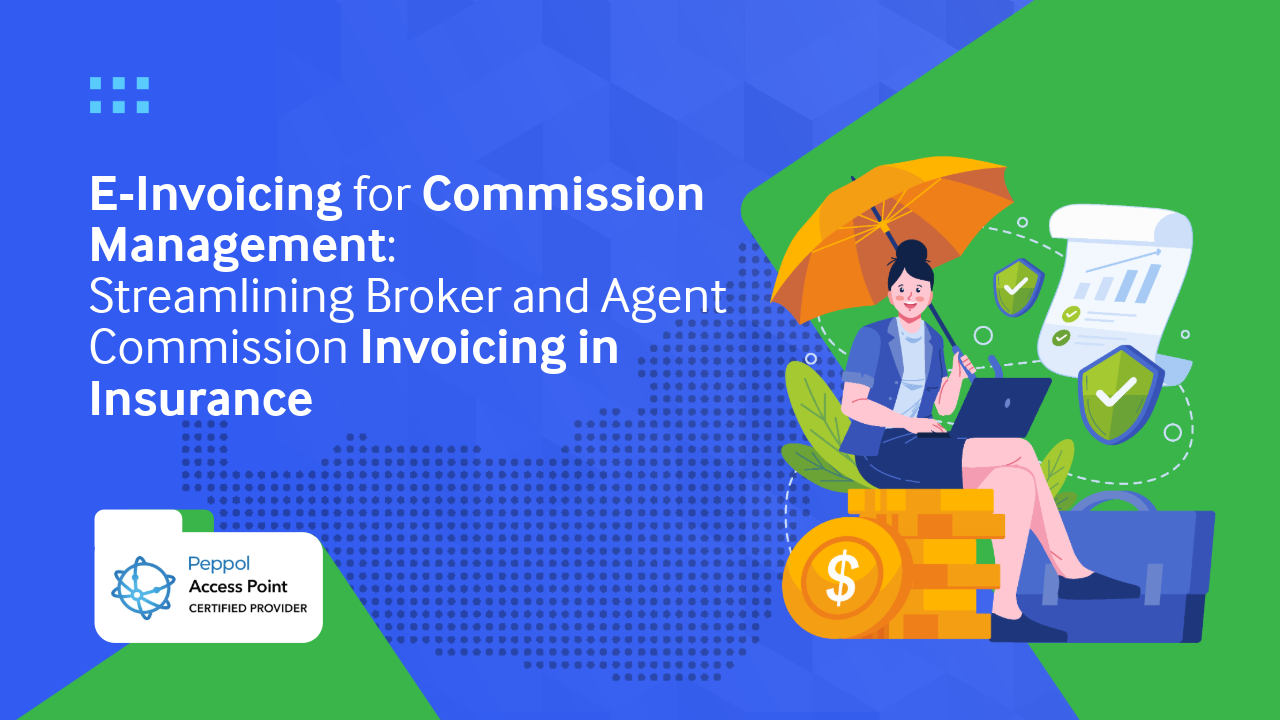
E-Invoicing for Commission
Management - Streamlining Broker and
Agent Commission Invoicing in Insurance

The insurance industry’s distribution model relies heavily on brokers and agents who connect carriers with policyholders. These intermediaries earn commissions that represent their primary income, making accurate and timely commission invoicing crucial to maintaining strong business relationships. Yet many insurers continue struggling with outdated manual processes that delay payments, create errors, and frustrate partners. Electronic invoicing software offers a transformative solution that streamlines commission management while strengthening the vital relationships driving insurance distribution.

The Commission Invoicing Challenge

Commission invoicing in insurance presents unique complexities. A single insurer might manage relationships with thousands of brokers, each operating under different agreements with varying commission rates, structures, and payment terms. These rates often differ by product line, policy type, premium volume, and whether policies represent new business or renewals.

Traditional workflows reflect this complexity through cumbersome processes. At each period’s end, insurers extract transaction data from policy systems, apply commission calculation rules, generate individual invoices for each broker, distribute documents via email or mail, field inquiries about calculations, process payments, and reconcile accounts. This multi-step process requires days or weeks, involves multiple departments, and creates numerous opportunities for errors and delays.

The consequences extend throughout organizations and beyond. Finance teams face extended month-end closings while awaiting commission finalizations. Brokers experience frustration with late payments or difficulty verifying calculation accuracy. Disputes consume time from both parties, damaging relationships and diverting attention from productive activities. Manual processes also create scalability limitations—adding distribution partners means proportionally increasing administrative overhead.

An e-invoice system fundamentally transforms commission invoicing by replacing paper documents and manual workflows with automated digital exchanges. Rather than generating PDF invoices requiring manual review and data entry, the best e-invoicing software transmits machine-readable data flowing directly between systems without human intervention.

The process begins with automated commission calculation engines determining amounts based on policy transactions and contractual terms. These calculations immediately trigger electronic invoice generation in standardized formats complying with tax and regulatory requirements. For insurers operating in the UAE, implementing an FTA-compliant E-invoicing Solution ensures adherence to Federal Tax Authority regulations, while PEPPOL e-invoicing enables seamless cross-border transactions with international partners.

Invoices are transmitted securely to broker systems through direct integrations, secure file transfers, or API connections. Brokers’ accounting systems automatically receive and process invoice data, matching against expected earnings, flagging exceptions, and queuing approved invoices for payment. This end-to-end automation eliminates delays, errors, and manual effort inherent in traditional approaches.


The advantages of implementing e-invoicing software manifest across multiple dimensions. Operational efficiency improves dramatically as automation eliminates manual data entry, document generation, and distribution tasks. Finance teams redirect time from repetitive processing to value-added activities like analysis and relationship management. Processing cycles compress from days to minutes.

Cost reductions emerge from eliminated paper, printing, and postage expenses, plus reduced labor for invoice processing, fewer error corrections, decreased dispute resolution effort, and lower support costs as brokers access self-service information. Many insurers working with top e-invoicing solution providers in UAE report 60-80% processing cost reductions.

Accuracy improvements stem from eliminating manual data handling. When calculations flow directly into invoice generation and broker systems without human transcription, error rates plummet. Automated validation catches issues before invoice generation, preventing rather than correcting problems.

Transparency and visibility transform commission management from a black box to a clear, accessible process. Modern e-invoice software platforms include self-service portals where brokers view invoices, drill into policy details, download data, track payments, and access historical information. This transparency dramatically reduces support inquiries while improving satisfaction.

Compliance and audit readiness improve through comprehensive digital documentation. For UAE-based insurers, partnering with an e-invoicing solution provider that offers FTA-accredited E-Invoicing Software in the UAE ensures full regulatory compliance while maintaining complete transaction records for audit purposes.

Essential Features of Best E-Invoicing Software

Effective e-invoicing solutions incorporate capabilities specifically designed for insurance distribution. Flexible invoice generation accommodates complex commission structures—multiple line items, adjustments for chargebacks, tiered rates, override payments, bonuses, and proper tax treatment across jurisdictions.

Multi-format and standards support ensures compatibility with diverse broker systems. The top e-invoicing solution in UAE should support Peppol e-Invoicing UAE solution standards for international transactions, FTA compliance for local operations, and multiple data formats to accommodate brokers with varying technological capabilities—from sophisticated agency management systems to basic accounting software.

Robust integration enables seamless data flow throughout the commission ecosystem. An E-Invoicing Solution for UAE must connect with commission calculation engines, policy administration platforms, accounting systems, payment platforms, and broker agency management systems. Modern API-based architectures enable real-time integration rather than batch processing.

Security features protect sensitive financial information through encryption, multi-factor authentication, role-based permissions, and comprehensive audit logging. Working with a trusted E-Invoicing Partner ensures that security standards meet both insurance industry requirements and UAE regulatory expectations.

Self-service portals empower brokers while reducing support burdens. Web-based interfaces let brokers view invoices, download data in various formats, drill into calculations, track payments, and generate custom reports.

Choosing the Right E-Invoicing Solution Provider

Selecting an e-invoicing software provider requires careful evaluation of several critical factors. UAE-based insurers should prioritize providers offering a comprehensive E-Invoicing Solution in UAE with proven insurance industry experience. Key selection criteria include FTA compliance certification, PEPPOL network connectivity for international operations, integration capabilities with existing policy and accounting systems, scalability to accommodate distribution network growth, and robust support services.

The best e-invoicing software in UAE should offer flexible deployment options—cloud-based for rapid implementation and minimal infrastructure requirements, or on-premises for organizations with specific security or control needs. E-invoicing solution providers should demonstrate deep understanding of insurance commission structures and regulatory requirements specific to both insurance operations and UAE tax compliance.

Implementation Strategies

Successful implementation requires careful planning across technical, operational, and relationship dimensions. Organizations should begin by documenting current processes, measuring cycle times and error rates, quantifying costs, identifying pain points, and establishing baseline metrics demonstrating success.

Stakeholder engagement proves critical. Internal stakeholders include finance teams, IT staff, operations personnel, and executives. External stakeholders—brokers and agents—vary enormously in size, sophistication, and system capabilities. Understanding this diversity shapes implementation strategy, particularly regarding rollout approach and format options.

Data preparation proves critical before deploying any e-invoice system. Accurate broker master data—identifiers, tax information, bank details, contact information, and commission terms—must exist before launch. Many organizations discover data quality issues requiring significant cleansing effort.

Phased rollout balances deployment speed against change management capacity. Many insurers segment broker populations and convert groups in waves—starting with technologically capable brokers, then expanding to less sophisticated partners. This allows support teams to manage change effectively while building organizational expertise.

Training and communication ensure successful adoption. Finance staff need workflow training, IT personnel require technical documentation, and brokers need clear communication about changes, benefits, access methods, and support resources.

Measuring Success and Ongoing Optimization

E-invoicing success should be measured against specific metrics: processing cycle times, cost per transaction, error and dispute rates, broker satisfaction scores, payment cycle times, and electronic adoption percentages. Organizations should track these metrics continuously, using insights to drive ongoing optimization and working closely with their e-invoicing software provider to implement enhancements.

The Strategic Advantage

Beyond operational efficiency, electronic invoicing software delivers strategic benefits. Real-time data access enables dynamic business intelligence for analyzing trends, identifying production patterns, spotting anomalies, and making data-driven distribution decisions. Improved broker relationships create competitive differentiation—fast, accurate, transparent commission processing signals professionalism and respect.

Scalability becomes nearly infinite with cloud-based e invoice software, enabling aggressive growth without proportional cost increases. Agility improves dramatically as new commission structures can be configured and deployed rapidly. For insurers operating across borders, Peppol e-Invoicing UAE solution capabilities enable seamless transactions with international reinsurers and brokers.

Conclusion

Commission management sits at the heart of insurance distribution economics and relationships. Implementing a comprehensive e-invoicing solution transforms it from an administrative burden into a strategic asset that strengthens relationships, reduces costs, and enables growth. For UAE-based insurers, partnering with top e-invoicing solution providers in UAE offering FTA-Accredited E-Invoicing Software ensures both operational excellence and regulatory compliance.

The technology has matured, the business case is compelling, and insurers still using traditional approaches face growing competitive disadvantage. Every period spent with manual processes represents wasted resources and frustrated brokers. Selecting the right e-invoicing software provider and implementing a robust E-Invoicing Solution for UAE positions insurers for success in an increasingly digital marketplace. The time to begin the transformation is now.

FAQ

Most frequent questions and answers

PEPPOL (Pan-European Public Procurement Online) is a global standard for electronic document exchange that enables businesses to send invoices, credit notes, and other documents securely across borders. For UAE businesses, it matters because the government has adopted the PEPPOL Continuous Transaction Control (CTC) model for mandatory e-invoicing implementation in July 2026. This means businesses must comply with both PEPPOL standards and Federal Tax Authority requirements to continue operations legally.

The UAE will implement mandatory e-invoicing in July 2026. All businesses operating in the UAE must be compliant by this deadline, which means they must have a PEPPOL-accredited e-invoicing solution in place that meets the Federal Tax Authority’s requirements.

SMARTeIS stands out by offering a single platform that handles both FTA compliance and PEPPOL submission, eliminating the need for multiple systems. It leverages AI-powered automation for invoice validation, integrates seamlessly with major ERP systems, and is officially listed by the UAE Ministry of Finance as a Pre-Approved Accredited E-Invoicing Service Provider. Additionally, it supports multilingual and multicurrency operations, and offers flexible deployment options.

SMARTeIS follows an 8-week implementation roadmap: Weeks 1-2 focus on assessment and planning, Weeks 3-4 cover setup and data migration, Weeks 5-6 include testing and training, and Weeks 7-8 handle go-live and hyper-care support. This structured approach ensures businesses achieve compliance without disrupting operations.

Yes, SMARTeIS integrates effortlessly with major ERP systems, including SAP, Oracle, Microsoft Dynamics, Odoo, QuickBooks, and Zoho. It also supports custom accounting systems through flexible integration methods, including APIs, SFTP, or manual uploads, making it compatible with virtually any business infrastructure.

SMARTeIS uses an AI-driven pre-validation engine that detects errors in VAT calculations, tax codes, and mandatory fields before submission. Only compliant invoices reach the PEPPOL network and FTA systems. When errors are detected, the platform provides clear, actionable guidance on corrections needed, with automatic rejection and resubmission workflows.

Yes, SMARTeIS is ISO 27001 certified, ensuring enterprise-grade data security. The platform maintains comprehensive audit trails, secure document archival for regulatory periods, encrypted data transmission, and role-based access controls—meeting the stringent requirements of both PEPPOL and FTA regulations.

Absolutely. SMARTeIS supports multi-lingual invoices (including Arabic), multiple currencies, and various tax jurisdictions within a single platform. By connecting to SMARTeIS, businesses gain access to the entire PEPPOL network spanning over 40 countries, making cross-border transactions as simple as domestic ones.

SMARTeIS offers flexible deployment options to suit different business needs and infrastructure requirements. It can be deployed as Platform-as-a-Service (PaaS) or Software-as-a-Service (SaaS), with options for cloud deployment or on-premises hosting, making it suitable for businesses of all sizes from SMEs to large enterprises.

Beyond compliance, SMARTeIS provides GenAI dashboards for predictive analytics, an AI chatbot for real-time queries and support, dynamic eReporting and tax analytics modules, customizable invoice templates and workflows, and multi-tenant architecture for centralized governance across entities. These features make it a comprehensive financial operations platform rather than just basic e-invoicing software.

Request Your Demo
Your Demo