
What Is E-Invoicing? A Deeper Dive
E-invoicing is the electronic generation, transmission, and processing of invoices in a structured, standardised format that enables automated validation and integration with tax authorities and business systems. Unlike PDFs or scanned copies, e-invoices contain machine-readable data that tax authorities can verify in near real-time through Continuous Transaction Controls (CTCs). This means invoices are not just digital copies — they are digitally "cleared" documents that comply with tax rules before payment processing.
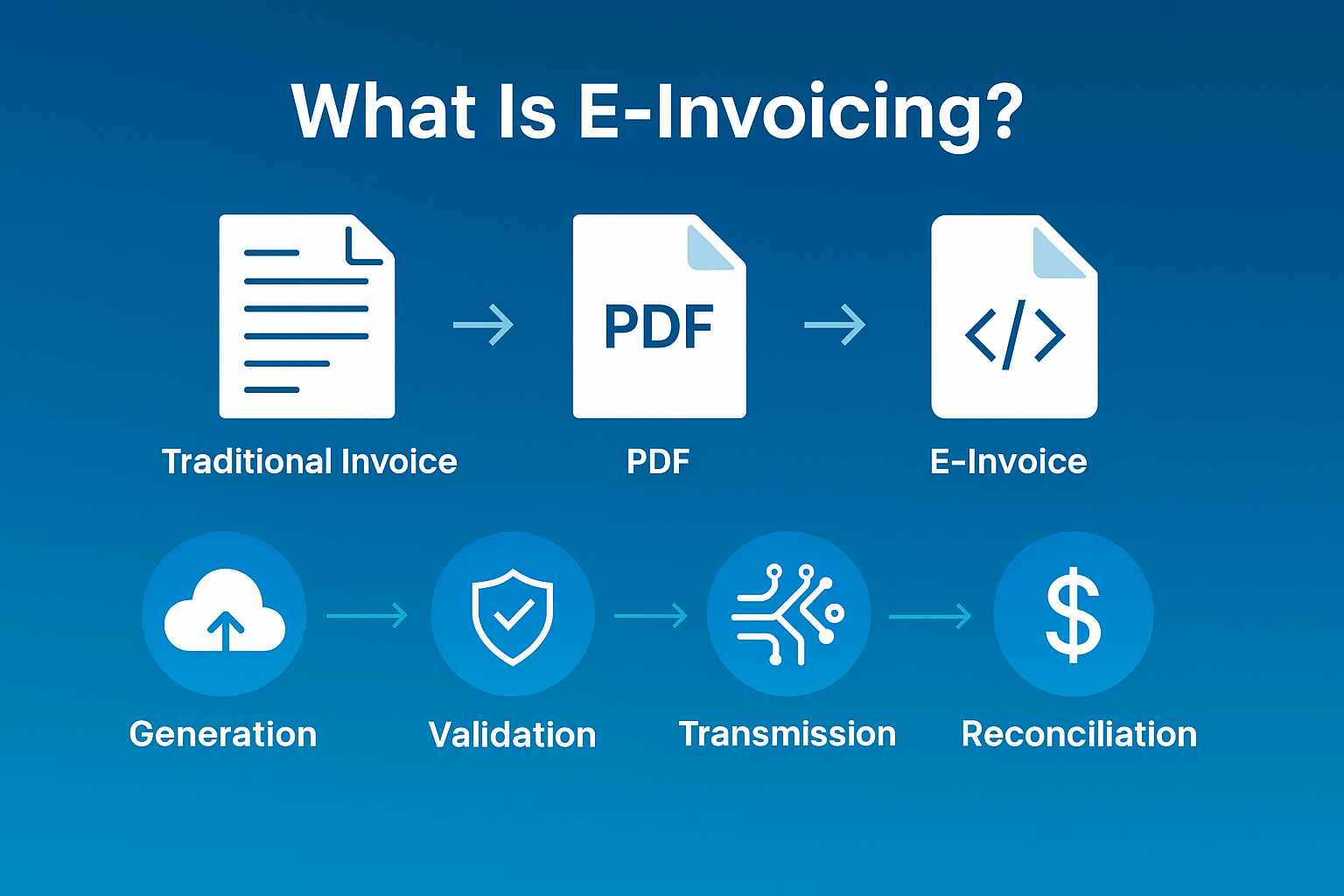
The e-invoice lifecycle now typically involves:
- Real-time Validation: Invoice data is submitted to tax authorities instantly or near-instantly, enabling immediate compliance checks and fraud detection.
- Standardised Formats and Protocols: Formats like EN 16931 in Europe and protocols such as Peppol enable interoperability across borders and systems.
- Automated Reconciliation: AI-driven tools automatically match invoices with purchase orders and payments, flagging discrepancies instantly.
Traditional Invoicing vs. E-Invoicing in 2025
| FEATURE | TRADITIONAL INVOICING | E-INVOICING (2025) |
|---|---|---|
| Format | Paper or PDF (unstructured) | Structured, machine-readable digital format |
| Validation | Manual, post-transaction checks | Real-time automated validation with tax authorities |
| Processing Speed | Slow, manual data entry and reconciliation | Instant processing with AI and automated matching |
| Compliance | Periodic, manual tax reporting | Continuous Transaction Controls (CTCs), real-time compliance |
| Cross-border Use | Complex, multiple formats and regulations | Interoperable standards (e.g., Peppol) for seamless global trade |
| Error Handling | Prone to errors, manual corrections | AI-driven anomaly detection and error flagging |
| Cash Flow Management | Delayed visibility, longer DSO | Real-time visibility, dynamic cash flow optimisation |
| Environmental Impact | High paper usage, carbon footprint | Paperless, eco-friendly, supports ESG goals |
| Cost Implications | Higher processing and storage costs | Reduced operational costs via automation |
| Audit & Fraud Control | Retrospective audits, limited fraud detection | Real-time transparency, fraud prevention with AI |
Why You Need E-Invoicing in 2025: Beyond the Basics
- Regulatory Imperative and Risk Mitigation — With over 80 countries enforcing e-invoicing mandates — including Malaysia, Germany, France, and Singapore — non-compliance now carries significant penalties and risks damaging supplier relationships. Malaysia's phased rollout through 2025 requires all businesses, regardless of size, to adopt e-invoicing, making early adoption critical to avoid fines and disruptions.
- AI-Powered Automation: The New Frontier — Artificial Intelligence is revolutionising e-invoicing by automating complex tasks such as data extraction, error detection, and compliance verification in real time. AI can instantly flag anomalies, reducing manual intervention and accelerating approval cycles. This shift allows finance teams to focus on strategic activities instead of repetitive data entry.
- Continuous Transaction Controls: Real-Time Tax Compliance — CTCs require businesses to transmit invoice data to tax authorities as transactions occur, enabling governments to monitor and audit in real time. This transparency reduces tax evasion and improves fiscal governance. Malaysia's MyInvois and Saudi Arabia's FATOORA platforms exemplify this trend, making compliance a continuous process rather than periodic reporting.
- Cross-Border Interoperability and Global Trade Facilitation — Standards like Peppol are enabling seamless e-invoice exchange across borders, simplifying compliance for multinational companies and boosting global trade efficiency. Countries like Belgium, Malaysia, and the UAE are adopting these frameworks to harmonise their e-invoicing ecosystems, reducing complexity and costs for exporters and importers.
- Strategic Cash Flow Optimisation — Beyond faster payments, e-invoicing provides real-time visibility into receivables and payables, enabling dynamic cash flow forecasting and working capital management. Automated invoice processing reduces Days Sales Outstanding (DSO), which can improve liquidity and reduce borrowing costs.
- Enhanced Data Analytics and Business Intelligence — Structured e-invoice data fuels advanced analytics, offering insights into spending patterns, supplier performance, and operational bottlenecks. This data-driven approach supports smarter procurement decisions and financial planning, transforming invoicing from a transactional activity into a strategic asset.
- Sustainability and Corporate Responsibility — E-invoicing significantly reduces paper consumption and carbon footprints, aligning with Environmental, Social, and Governance (ESG) goals. Businesses adopting e-invoicing demonstrate commitment to sustainability, which is increasingly valued by investors, customers, and regulators.
The Bottom Line
E-invoicing in 2025 is not just a compliance checkbox — it is a transformative enabler of digital finance, operational efficiency, and global trade competitiveness. Its integration with AI, real-time tax reporting, and cross-border standards is reshaping how businesses manage cash flow, compliance, and supplier relationships.
To stay ahead, businesses must embrace e-invoicing as part of a broader digital transformation strategy — leveraging its capabilities to reduce costs, mitigate risks, and unlock new growth opportunities in an increasingly interconnected and regulated global economy.
Is Your Business E-Invoicing Ready for 2025?
At SMARTeIS, we help businesses across Malaysia, the UAE, Singapore, and Europe transition to fully compliant e-invoicing — with AI-powered automation, real-time tax authority validation, Peppol integration, and seamless ERP connectivity built in.
The future of invoicing is already here. Book Your Free Demo today!