
Skill Quotient Technologies

E-Invoicing Bilingual Requirements in UAE: Solving Arabic-English Dual Language Challenges

The United Arab Emirates Federal Tax Authority (FTA) has established strict bilingual requirements for electronic invoicing software, creating unique technical challenges for businesses operating in the region. As companies rush to implement FTA compliant e-invoicing solutions, understanding how to properly handle Arabic-English dual language invoicing has become critical for compliance and operational efficiency.

Understanding UAE's Bilingual E-Invoicing Mandate

The FTA’s e-invoicing regulations require that all tax invoices generated through an e invoice system must contain information in both Arabic and English languages. This isn’t merely a translation requirement—it’s a technical implementation challenge that demands proper handling of right-to-left (RTL) text, Unicode character encoding, and bilingual PDF generation while maintaining the integrity of structured data formats required for PEPPOL e-invoicing standards.

For businesses searching for the best e-invoicing software in UAE, bilingual capability isn’t optional—it’s a fundamental compliance requirement that separates compliant solutions from those that will face FTA penalties.

1. Unicode and Character Encoding Standards

Arabic text requires proper Unicode implementation (UTF-8 encoding) to ensure characters display correctly across all systems. The top e-invoicing solution in UAE must handle:

  • Arabic Unicode blocks (U+0600 to U+06FF for basic Arabic, U+0750 to U+077F for Arabic Supplement)
  • Proper glyph rendering for connected Arabic letters that change shape based on position
  • Diacritical marks and special characters used in formal Arabic business language
  • Number formatting differences (Western vs Eastern Arabic numerals)

An FTA-accredited e-invoicing software in UAE that fails to implement proper Unicode handling will generate invoices with garbled Arabic text, leading to compliance violations and customer confusion.

2. Right-to-Left (RTL) Text Formatting

Arabic is written right-to-left while English is left-to-right, creating complex layout challenges for e-invoicing solution providers. The e-invoicing solution in UAE must support:

Bidirectional Text Algorithm (BiDi): Proper implementation of Unicode BiDi standards ensures mixed Arabic-English text flows correctly. For example, an invoice line item like “Laptop Dell XPS 13 – لابتوب ديل” must render with correct directionality for each language segment.

PDF Layout Considerations: E invoice software must generate PDFs where Arabic sections align right-to-left while maintaining standard left-to-right alignment for English sections, tables, and numerical data.

Table and Column Alignment: Invoice tables containing bilingual content require intelligent column mirroring. The best e-invoicing software in UAE handles this automatically, ensuring Arabic headers align right while English headers align left.

 
3. Dual Language Data Structure

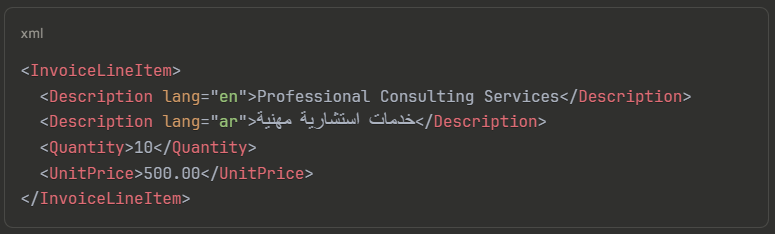
Beyond visual presentation, an FTA compliant e-invoicing solution must structure data to accommodate both languages at the XML/JSON level for PEPPOL e-invoicing UAE solution compliance:


Electronic invoicing software that stores only single-language data and applies translation layers afterward often fails FTA audits, as the original invoice data must contain both languages natively.

When evaluating e-invoicing software providers for UAE operations, businesses should prioritize these technical capabilities:

  • Automated Bilingual Content Generation

The top e-invoicing solution in UAE should offer automated translation and bilingual content management for standard invoice elements including product descriptions, terms and conditions, payment instructions, and legal disclaimers. Manual dual-entry creates errors and operational inefficiency.

  • Arabic-English Template Customization

Your e-invoicing partner should provide pre-built bilingual invoice templates that comply with FTA visual and content requirements while allowing customization for brand identity. Templates must handle variable-length text in both languages without breaking layouts.

  • Font Rendering and Embedding

Proper Arabic font support is critical. The e invoice system must embed Arabic-capable fonts in PDF generation to ensure invoices display correctly when opened on any device, regardless of installed fonts. Traditional Arabic fonts like “Arial Unicode MS” or modern options like “Dubai Font” ensure readability.

  • Database Schema for Multilingual Data

Backend architecture matters. E-invoicing solution providers should implement database schemas that natively support multilingual content storage, not bolted-on translation tables. This ensures data integrity during audits and system migrations.

PEPPOL E-Invoicing and Arabic Language Support

The PEPPOL network, increasingly adopted for B2G (business-to-government) transactions in the GCC region, presents additional considerations for bilingual e-invoicing. While PEPPOL standards are designed for international interoperability, implementing a PEPPOL e-invoicing UAE solution requires:

  • Language Code Specification: Proper use of ISO 639-1 language codes (ar for Arabic, en for English) in PEPPOL BIS (Business Interoperability Specifications) documents ensures receiving systems can identify and process bilingual content correctly.
  • UBL Format Compliance: The Universal Business Language (UBL) XML format used in PEPPOL must accommodate multilingual description fields. Your Peppol e-Invoicing UAE solution should validate that both Arabic and English content meets schema requirements.
  • Cross-Border Considerations: When exchanging invoices with international partners through PEPPOL, the e-invoicing solution in UAE must determine which language to prioritize in the main fields while preserving bilingual data in additional fields for local compliance.

Implementation Considerations for UAE Businesses

Choosing Between Cloud and On-Premise Solutions
  • Cloud-Based E-Invoicing Solutions: Most FTA-accredited e-invoicing software in UAE operates on cloud infrastructure, providing automatic updates to comply with evolving FTA requirements including bilingual formatting standards. Cloud solutions typically offer better Arabic font rendering and cross-device compatibility.
  • On-Premise E Invoice Systems: Larger enterprises with existing ERP systems may prefer on-premise integration. When selecting e-invoicing software providers for on-premise deployment, verify their Arabic language pack includes all necessary fonts, rendering engines, and regular updates for FTA compliance changes.
Integration with Existing Business Systems

The best e-invoicing software in UAE seamlessly integrates with your existing accounting, ERP, and CRM systems while maintaining bilingual data integrity throughout the workflow:

  • Data Flow Mapping: Ensure your e-invoicing partner maps both Arabic and English fields from source systems correctly. Product master data should maintain bilingual descriptions that flow automatically into invoices.
  • API Language Support: If building custom integrations, verify the e invoice software API supports language parameter specifications for both data input and document generation.
  • User Interface Localization: Staff training and adoption improve when the e-invoicing system interface itself supports Arabic, not just generated invoices.

Compliance and Audit Readiness

FTA audits will scrutinize bilingual invoice implementation. Your e-invoicing solution in UAE should provide:

Audit Trail Documentation

Complete logging of bilingual content generation, including timestamps for Arabic and English text entry, translation approval workflows, and version history of bilingual invoice templates.

FTA Reporting Capabilities

The e invoice system must generate compliance reports demonstrating that all issued invoices contain required bilingual elements. Top e-invoicing solution providers in UAE offer FTA-specific audit reports highlighting any invoices with missing or malformed Arabic/English content.

Archive and Retrieval

Seven-year invoice retention requirements apply to bilingual documents. Your FTA compliant e-invoicing solution must store invoices in searchable formats supporting queries in both Arabic and English, with proper indexing of bilingual metadata.

Common Bilingual E-Invoicing Pitfalls to Avoid

Translation Quality Issues

Machine-translated Arabic often contains grammatical errors or uses inappropriate register for business communication. The best e-invoicing software in UAE incorporates professionally translated standard terms and allows businesses to maintain a glossary of industry-specific terminology in both languages.

Inconsistent Number Formats

UAE invoices must display amounts clearly. While Arabic Eastern numerals (٠١٢٣٤) exist, business practice typically uses Western Arabic numerals (0123) for financial figures. Your e-invoicing software provider should configure number formatting according to FTA guidelines and business norms.

PDF Generation Failures

Complex bilingual PDFs can fail to render correctly across different PDF viewers. An FTA-accredited e-invoicing software in UAE should test PDF output across multiple platforms (Adobe Reader, browser viewers, mobile apps) to ensure consistent rendering.

Data Export Problems

When exporting invoice data for analysis or migration, ensure the e invoice system properly exports Arabic text without corruption. UTF-8 encoding must be maintained throughout export processes (CSV, Excel, JSON) to preserve Arabic characters.

Selecting Your E-Invoicing Partner for UAE Operations

The choice of e-invoicing solution providers significantly impacts your compliance success and operational efficiency. When evaluating options:

  • Verify FTA Accreditation: Only work with FTA-accredited e-invoicing software in UAE. Check the FTA’s official list of approved solution providers who have demonstrated bilingual compliance capability.
  • Request Arabic Demo: Don’t rely on English-only demonstrations. Test the e-invoicing solution in UAE with actual Arabic product descriptions, customer names, and addresses to verify proper rendering.
  • Check Integration Track Record: Ask potential e-invoicing partners for case studies of similar UAE businesses they’ve implemented, specifically highlighting bilingual integration challenges resolved.
  • Evaluate Support Capabilities: Technical support for Arabic text issues requires specialized knowledge. Ensure your e-invoicing software provider offers Arabic-speaking support staff familiar with RTL formatting and Unicode troubleshooting.
  • Assess Scalability: As your business grows, invoice volume and complexity increase. The top e-invoicing solution in UAE should handle thousands of bilingual invoices daily without performance degradation.

Future-Proofing Your Bilingual E-Invoicing Implementation

UAE’s e-invoicing landscape continues to evolve. Your PEPPOL e-invoicing solution should be flexible enough to accommodate:

  • Enhanced Arabic Content Requirements: Future FTA updates may mandate additional bilingual fields or specific Arabic terminology for certain transaction types.
  • GCC Integration: As Gulf Cooperation Council countries harmonize e-invoicing standards, cross-border bilingual requirements may expand. Your e-invoicing solution in UAE should support KSA’s ZATCA requirements and Bahrain’s NBR standards alongside FTA compliance.

AI-Powered Translation: Next-generation electronic invoicing software incorporates AI to improve Arabic translation quality and context-aware terminology selection based on industry and transaction type.

Conclusion

Successfully implementing bilingual e-invoicing isn’t merely a compliance checkbox—it’s an operational excellence opportunity. Businesses using the best e-invoicing software in UAE report improved customer satisfaction, faster payment cycles, and reduced disputes when Arabic-speaking customers receive properly formatted, professional Arabic invoices.

By partnering with an experienced e-invoicing solution provider who understands the technical nuances of Arabic-English implementation, UAE businesses position themselves for sustainable growth in a digitally transformed economy. The investment in proper bilingual e invoice software today prevents costly compliance violations and system replacements tomorrow.

Whether you’re implementing your first e-invoicing system or upgrading from a non-compliant solution, prioritize bilingual capability as a core requirement, not an afterthought. The right FTA compliant e-invoicing solution will handle Arabic-English complexity seamlessly, allowing your team to focus on business growth rather than technical troubleshooting.

FAQ

Most frequent questions and answers

PEPPOL (Pan-European Public Procurement Online) is a global standard for electronic document exchange that enables businesses to send invoices, credit notes, and other documents securely across borders. For UAE businesses, it matters because the government has adopted the PEPPOL Continuous Transaction Control (CTC) model for mandatory e-invoicing implementation in July 2026. This means businesses must comply with both PEPPOL standards and Federal Tax Authority requirements to continue operations legally.

The UAE will implement mandatory e-invoicing in July 2026. All businesses operating in the UAE must be compliant by this deadline, which means they must have a PEPPOL-accredited e-invoicing solution in place that meets the Federal Tax Authority’s requirements.

SMARTeIS stands out by offering a single platform that handles both FTA compliance and PEPPOL submission, eliminating the need for multiple systems. It leverages AI-powered automation for invoice validation, integrates seamlessly with major ERP systems, and is officially listed by the UAE Ministry of Finance as a Pre-Approved Accredited E-Invoicing Service Provider. Additionally, it supports multilingual and multicurrency operations, and offers flexible deployment options.

SMARTeIS follows an 8-week implementation roadmap: Weeks 1-2 focus on assessment and planning, Weeks 3-4 cover setup and data migration, Weeks 5-6 include testing and training, and Weeks 7-8 handle go-live and hyper-care support. This structured approach ensures businesses achieve compliance without disrupting operations.

Yes, SMARTeIS integrates effortlessly with major ERP systems, including SAP, Oracle, Microsoft Dynamics, Odoo, QuickBooks, and Zoho. It also supports custom accounting systems through flexible integration methods, including APIs, SFTP, or manual uploads, making it compatible with virtually any business infrastructure.

SMARTeIS uses an AI-driven pre-validation engine that detects errors in VAT calculations, tax codes, and mandatory fields before submission. Only compliant invoices reach the PEPPOL network and FTA systems. When errors are detected, the platform provides clear, actionable guidance on corrections needed, with automatic rejection and resubmission workflows.

Yes, SMARTeIS is ISO 27001 certified, ensuring enterprise-grade data security. The platform maintains comprehensive audit trails, secure document archival for regulatory periods, encrypted data transmission, and role-based access controls—meeting the stringent requirements of both PEPPOL and FTA regulations.

Absolutely. SMARTeIS supports multi-lingual invoices (including Arabic), multiple currencies, and various tax jurisdictions within a single platform. By connecting to SMARTeIS, businesses gain access to the entire PEPPOL network spanning over 40 countries, making cross-border transactions as simple as domestic ones.

SMARTeIS offers flexible deployment options to suit different business needs and infrastructure requirements. It can be deployed as Platform-as-a-Service (PaaS) or Software-as-a-Service (SaaS), with options for cloud deployment or on-premises hosting, making it suitable for businesses of all sizes from SMEs to large enterprises.

Beyond compliance, SMARTeIS provides GenAI dashboards for predictive analytics, an AI chatbot for real-time queries and support, dynamic eReporting and tax analytics modules, customizable invoice templates and workflows, and multi-tenant architecture for centralized governance across entities. These features make it a comprehensive financial operations platform rather than just basic e-invoicing software.

Request Your Demo
Your Demo